Last Updated on June 8, 2026 by David
Transform Dull Slate Floors in Renfrewshire with Professional Restoration Services
Recognising the Indicators: When Regular Cleaning is Insufficient for Slate Floors
In many cases, slate floors in Renfrewshire become so worn that standard cleaning techniques fail to enhance their appearance. The surface might seem intact, yet the colour often appears muted, with clear wear patterns visible in high-traffic areas. The lively finish typically expected in spaces like kitchens, hallways, utility rooms, or entrances is noticeably absent.
From my observations, the absence of shine in slate floors usually points to a problem with the finish rather than a structural issue. These surfaces often show marks easily, dry unevenly after mopping, and tend to trap grey soil in the deeper parts of their natural split texture. At this point, the necessity of professional slate restoration becomes apparent, as routine household cleaning proves inadequate.
Understanding the Uneven Texture: What Causes Slate Floors to Look Patchy?
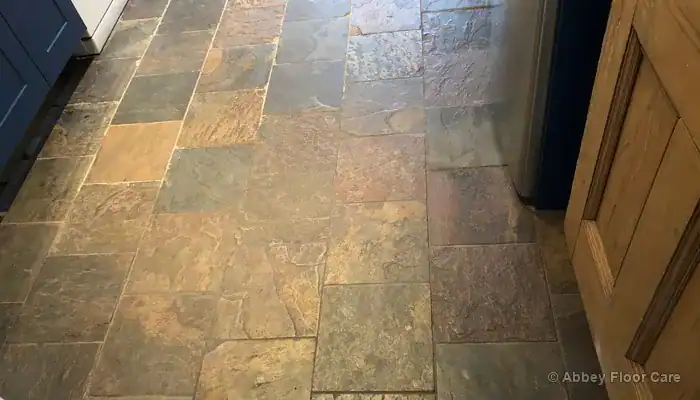
The natural split texture of slate adds to its unique character but can also result in a patchy appearance as the surface wears. Certain tiles may appear darker, while others accumulate old coatings along their edges. Low areas can trap residue long after the rest of the floor has dried.
This unevenness does not necessarily indicate a widespread failure across all tiles. A slate floor in Renfrewshire could consist of a blend of older Welsh stone, imported Indian slate, or various domestic tiles, each exhibiting different colours, densities, and surface characteristics. This natural variety enhances the floor’s charm. The presence of greasy edges, lightened traffic patterns, and cloudy patches signifies that the finish needs thorough evaluation.
What Level of Shine Can You Realistically Expect from Slate Restoration?
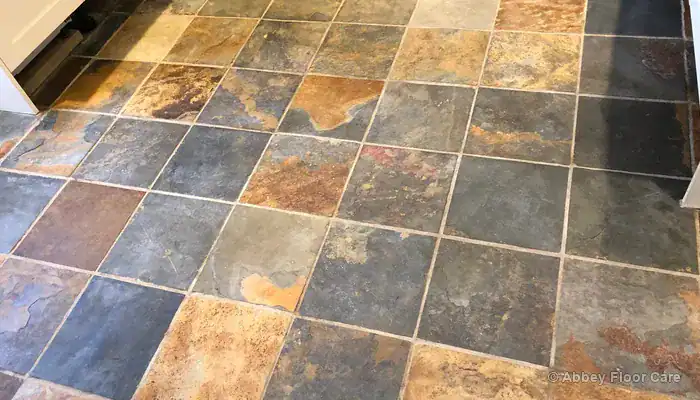
Many homeowners grapple with setting realistic expectations regarding shine when considering slate restoration in Renfrewshire. A common question arises concerning whether slate can be polished, but a more relevant inquiry is whether the floor can regain its colour depth, achieve a controlled sheen, and withstand daily wear.
Generally, riven slate does not attain a mirror-like shine without sacrificing the texture that makes it distinctive. A finely honed slate surface disperses light evenly, while an impregnating sealer preserves the natural riven texture. In contrast, a topical sealer may offer a slight sheen.
Slate chosen for older Scottish homes, converted properties, and modern kitchens is often selected for its colour and texture rather than its ability to reflect light uniformly. Restoration professionals should clarify the homeowner’s desired outcome, whether that is a natural enriched finish, a satin glow, or a subtle low-gloss coating before discussing any polishing techniques.
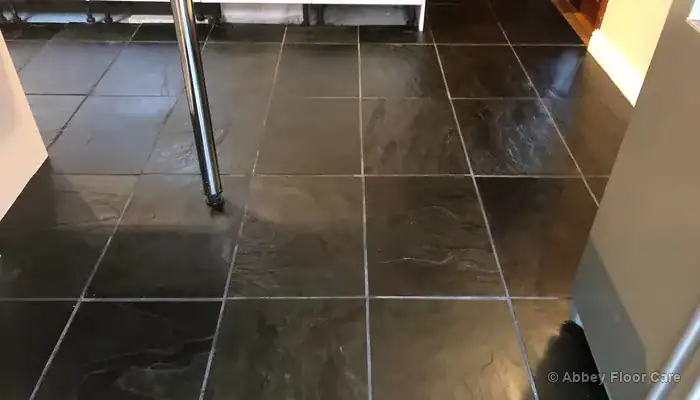
Abbey Floor Care provides slate restoration services in Renfrewshire, focusing on local evaluations and connecting clients with a network of vetted contractors serving central Scotland. The initial assessment determines the floor’s condition, the current state of the finish, and the cause of visible dullness, whether arising from worn protection, outdated coatings, surface contamination, or unrealistic finish expectations.
Local service delivery is essential, as slate floors can differ significantly across Scottish homes. Properties in and around Paisley, Renfrew, Johnstone, and nearby villages may feature older slate or newer replacement tiles, while contemporary kitchens might incorporate softer, imported slate. Although visible issues may appear similar, treatment methods can vary considerably.
Insights gained from slate restoration projects across the UK emphasise a crucial lesson: successful restoration outcomes begin with meticulous inspection rather than assumptions. The Matlock slate restoration case study illustrates how riven textures, outdated coatings, careful cleaning, and finishing decisions intersect in a practical service context. This information underlines the need to approach restoration as a managed process rather than merely applying a “polish” product.
Homeowners comparing dull slate floors to online polish recommendations may develop unrealistic expectations. Product-focused shine advice often overlooks crucial factors such as surface texture, wear patterns, prior sealers, and the distinction between a light-reflective coating and a properly maintained stone surface. A local restoration expert should assist homeowners in evaluating their floor’s condition before encouraging them to seek professional assessment.
The aim of slate restoration in Renfrewshire is to equip homeowners with a clear understanding of their floor’s condition prior to commencing any work. Key visible indicators include a loss of colour depth, patchy coatings, rapid re-soiling, lightened traffic lanes, edge build-up, uneven drying, and a finish that no longer responds to standard maintenance. These signs indicate the need for specialist inspection rather than merely stronger mopping or abrasive scrubbing.
Why Evaluating Existing Coatings and Previous Treatments is Crucial
Old coatings and prior treatments can obscure the true condition of a slate floor until restoration efforts begin. When a sealer fails, it indicates that the protective layer has deteriorated, resulting in cloudy patches, lightened traffic areas, sticky edges, or sections that quickly darken. Effective restoration starts with a comprehensive understanding of the remaining surface before applying any new protection.
Understanding existing coatings is vital for planning a safe and effective slate restoration process.
Layer separation presents a unique challenge for slate, as the stone can split along its natural sheet-like boundaries. Homeowners may notice flaking, raised edges, or small loose layers, rather than simply dirt. Addressing this issue requires stabilization or careful avoidance of aggressive treatments prior to cleaning or sealing. The slate flaking diagnostic guide offers additional context regarding this damage pattern without turning the Renfrewshire service page into a detailed repair guide.
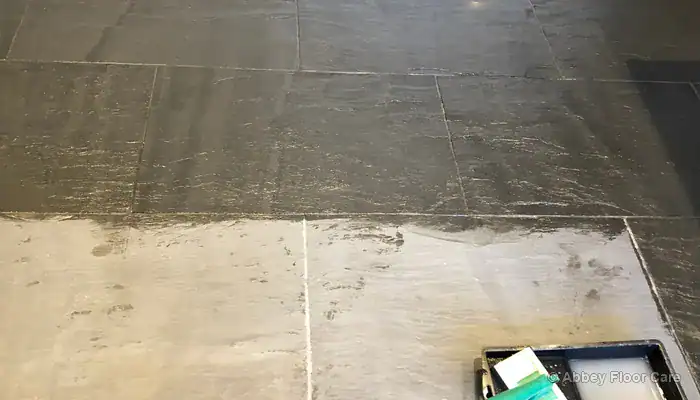
Removing old coatings should be viewed as a necessary preparatory step rather than an optional cosmetic enhancement. Residue from outdated acrylic can build up in tile edges, grout lines, and low-traffic corners, necessitating thorough stripping before the floor can accept a uniform finish. Applying fresh sealer over contaminated residue will only recreate the same patchy appearance that homeowners wish to eliminate.
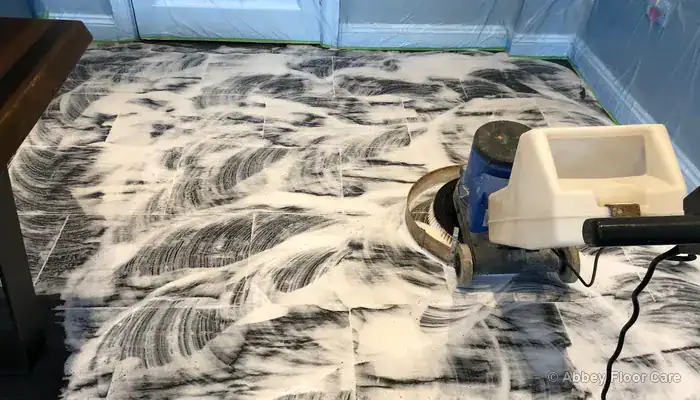
Essential Tools for Safe Slate Cleaning, Stripping, and Contaminant Removal
Utilising inappropriate cleaning or stripping techniques can inadvertently drive contaminants deeper into the slate’s texture rather than effectively removing them. The riven ridges, recessed troughs, grout joints, and open surface relief can trap loosened debris. Any wet cleaning must involve controlled agitation followed by immediate extraction, rather than relying on loose mopping.
Professional restoration employs compatible stripping chemicals, brush agitation, pressurised rinsing, and wet vacuum recovery to eliminate old residues from the floor. A solvent-based stripper softens suitable old coatings while a wet vacuum or slurry extractor promptly removes liquefied soil before it can dry back into the surface. The professional slate restoration techniques guide provides further insights into the specialised processes for those seeking a deeper understanding.
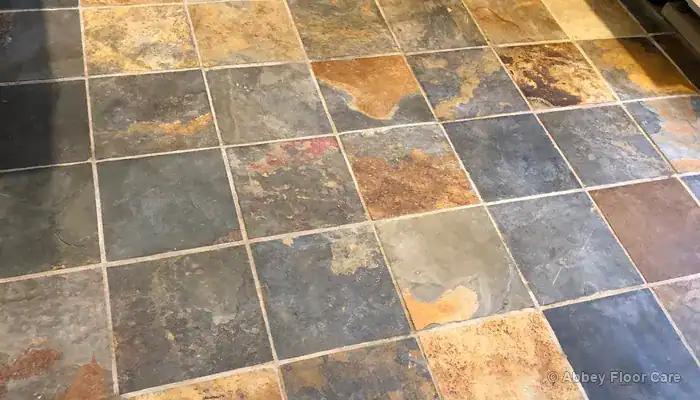
Experience with slate is crucial, as the stone’s origin influences how much water, cleaner, and sealer the surface can tolerate. Dense Welsh slate behaves differently from softer imported varieties, necessitating adjustments in drying times, rinsing intensity, and finish selection. The objective is to achieve a floor that is genuinely cleaner beneath the finish, rather than merely appearing darker for a brief period.
What to Expect from the Appearance of a Restored Slate Floor in Renfrewshire
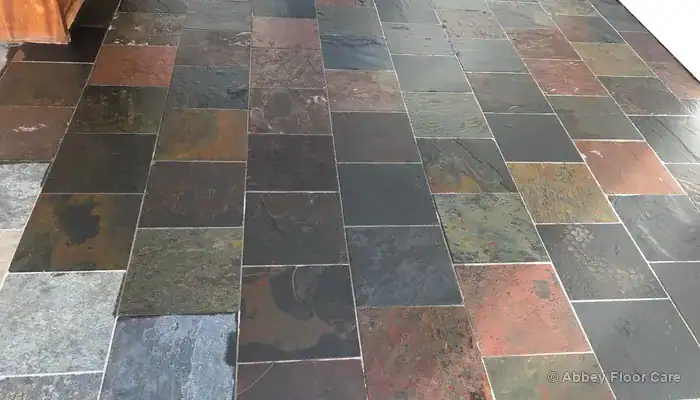
A successfully restored slate floor should look cleaner, richer, and be easier to maintain while retaining its natural slate characteristics. Colour loss manifests as visible fading due to foot traffic wearing away the pigmented surface and old finish, potentially resulting in lighter walkways or uneven patches. Effective restoration relies on controlled cleaning, removal of coatings, and application of the correct sealer rather than promising a shiny finish.
Natural colour recovery enhances the depth of riven slate while preserving the original surface’s character. A colour-enhancing finish accentuates the mineral tones and contrasts, yielding a more defined appearance without enforcing uniformity across each tile. The wet-look slate finish guide elaborates on the differences between achieving colour depth and surface sheen.
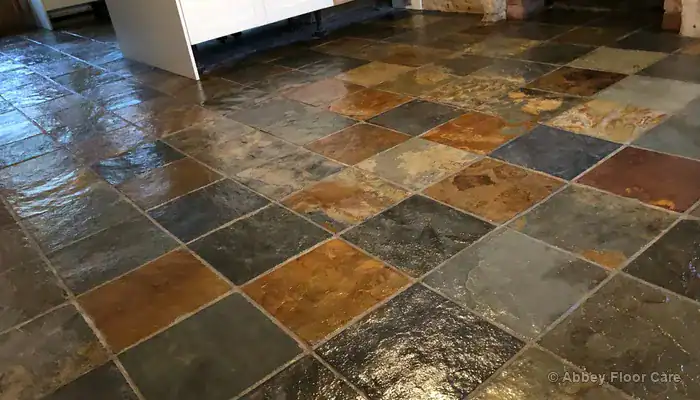
Unrealistic polish expectations often lead to disappointment when homeowners expect textured slate to reflect light like a smooth stone. A topical urethane film can create a low sheen or gloss, as the coating acts as the reflective layer; however, this finish has a limited lifespan and demands careful maintenance. The restored floor should remain cleaner for longer and respond more predictably to routine upkeep compared to an unprotected or residue-laden surface.
Enhance Your Knowledge of Slate Floor Care Prior to Selecting Restoration Methods
Making an informed decision about the optimal restoration approach begins with understanding the capabilities and limitations of slate. Issues such as dullness, coating failures, flaking risks, colour enhancement, and shine expectations all fall within the broader context of slate as a flooring material. This knowledge can guide homeowners in determining if a local assessment is the next logical step.
This Renfrewshire service page is dedicated to professional evaluations, outlining the range of restoration services and providing realistic expectations for local slate floors. For broader insights into slate behaviour, finish limitations, cleaning responses, and long-term maintenance, please refer to the main slate floor care hub. Common maintenance queries regarding dull floors are addressed separately in the slate cleaning guide for dull floors. This structure ensures that restoration decisions remain clear without transforming a local service page into an extensive maintenance manual.

David Allen — Abbey Floor Care
With over 30 years of hands-on experience restoring slate floors across the UK, David Allen provides expert guidance through Abbey Floor Care. His extensive knowledge encompasses local building styles, historical floor conditions, and effective restoration strategies that yield lasting results.
The article Dull Slate Floors In Renfrewshire Need More Than Polish first appeared on https://www.abbeyfloorcare.co.uk
The Article Slate Floors in Renfrewshire: Beyond Just a Polish appeared first on https://fabritec.org
The Article Slate Floors in Renfrewshire: More Than Just Polish Was Found On https://limitsofstrategy.com
The Article Slate Floors in Renfrewshire: Beyond Basic Polishing found first on https://electroquench.com